MONAD (MON)
Promising Contender for Wall Street's third‑rail, high‑performance EVM execution layer

There’s Bitcoin as the established, tested store of value, and then there’s the whole ecosystem evolving around it. Let’s explore (*nothing here is financial advice*)
The New Crypto Rails: ETH, SOL… and the Quiet Third Contender
Tom Lee recently said something that cuts through the noise:
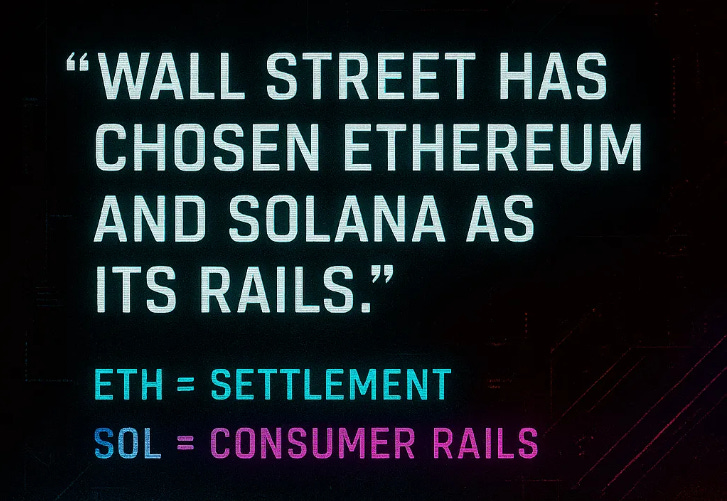
Wall Street has already chosen its crypto rails — Ethereum and Solana.
He’s right.
Ethereum has become the institutional settlement layer
Solana has emerged as the high‑throughput consumer rail
But here’s the part most people are missing:
If ETH is the NYSE and SOL is Visa, there’s still an open lane —
a high‑performance execution layer that keeps the EVM ecosystem intact.
And that’s where Monad (MON) enters the picture.
Why Monad Matters in a Two‑Rail World
Monad isn’t trying to replace Ethereum or Solana.
It’s solving the problem between them:
How do you get Solana‑level speed without leaving the Ethereum universe?
Monad’s answer is a parallelized, high‑throughput EVM chain that delivers:
Solana‑class performance
Ethereum‑native tooling
Deterministic parallel execution
Sub‑second finality
Full Solidity compatibility
This creates a third rail that institutions actually want:
“The institutional EVM execution rail.”
No new languages.
No new mental models.
No new custody frameworks.
Just speed — inside the EVM world institutions already understand.
Why Institutions Are Paying Attention
Look at the hiring pattern. Monad has quietly pulled in senior talent from:
FalconX
BVNK
Optimism
JP Morgan
Deutsche Bank
Amazon
These aren’t hype hires.
They’re capital‑markets, infrastructure, and institutional‑growth hires.
The message is clear:
Monad is building for the same audience that chose Ethereum —
but with the performance profile that made Solana impossible to ignore.
So Is MON a Leading Contender in This Narrative?
Yes — if Tom Lee’s framework is right, MON is one of the strongest asymmetric bets in the “rails” thesis.
Not as a replacement for ETH or SOL.
But as the third rail that completes the system:
ETH = settlement
SOL = consumer rails
MON = high‑performance EVM execution
It’s the only chain aiming squarely at that intersection.
Other Contenders Worth Watching
A few others are trying to play in the high‑performance lane, but none fit the institutional EVM narrative as cleanly:
SUI — strong tech, not EVM
APTOS — great engineering, weak ecosystem
SEI — interesting EVM layer coming, but early
AVAX — subnets are clever, but momentum has faded
NEAR — excellent tech, no institutional angle
Among these, Monad may be the purest expression of the “Solana‑speed EVM” thesis.
The Bottom Line
If Wall Street has already chosen:
Ethereum for trust and settlement
Solana for throughput and consumer rails
Then the open question is:
Who becomes the execution engine institutions use when they want Solana‑level performance without leaving the EVM?
Right now, Monad may well be the leading answer.
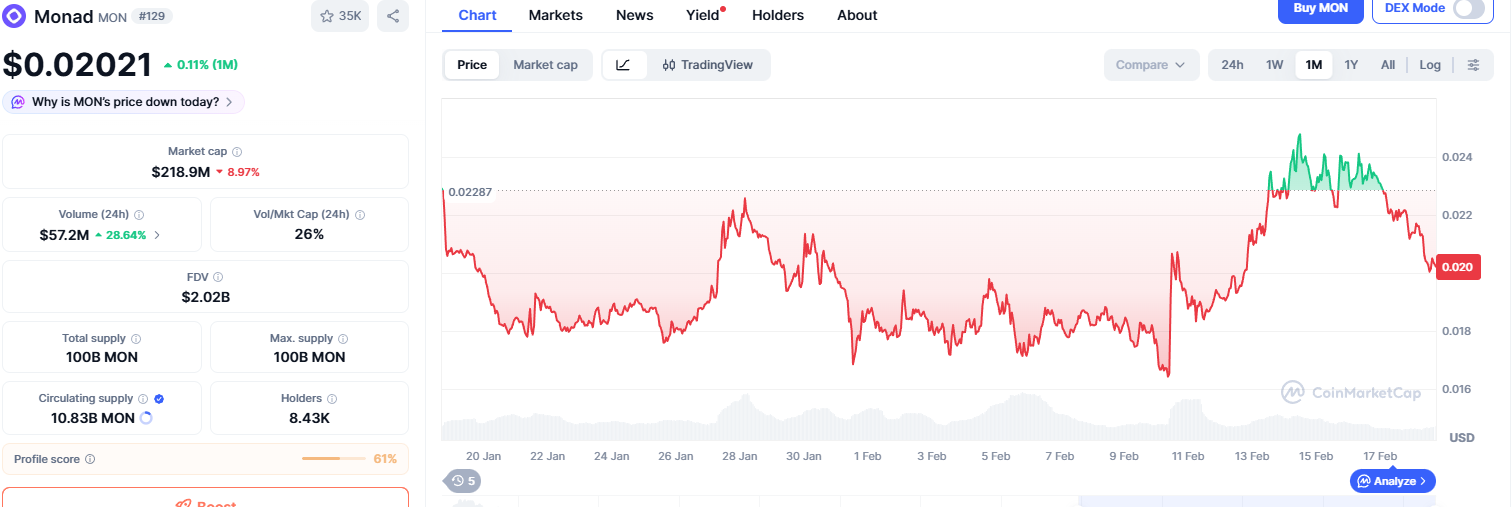
And it’s early days. A little could go a very long way for the patient. No need for leverage or perping…
*This is education, not advice. Always do your own due diligence
Artificial intelligence is the great equalizer and deflation is coming. Bitcoin will be on the receiving end of the redistribution of capital into scarce assets.
Everyone needs to listen to this.
Jordi Visser: https://x.com/TheBTCTherapist/status/2026121764716028217
Ric Edelman (Top US wealth advisor 20 yrs running) reposted:
Digital Assets Council of Financial Professionals
Feb 19
Can bitcoin reach $500,000 by 2030?
@ricedelman
believes it can, and his reasoning is not based on hype. It is based on allocation math.
If global diversified portfolios allocated just 1% to bitcoin, that would imply roughly $7.5 trillion of inflows into the asset class.
That level of adoption translates to approximately $500,000 per coin.
In this interview with
@AltcoinDaily
, Ric explains the arithmetic behind the thesis and why adoption, not speculation, is the driver.
Watch here: https://hubs.li/Q043C5XF0